
Hluhluwe-iMfolozi Park is where most of our safaris from Durban take you, and it is the reason we started running them. It is about three hours’ drive north of the city, in the rolling hills of Zululand, and it is home to all of the Big 5. It is also the place that saved the white rhino from extinction. This page is our guide to the park: its story, its landscapes, the animals you can hope to see and how to get the most out of a visit.
The park at a glance
- Where: northern KwaZulu-Natal, about 280 km north of Durban
- Size: around 96,000 hectares of hills, river valleys, grassland and thornveld
- Proclaimed: 1895, which makes it one of the oldest game reserves in Africa
- Big 5: lion, leopard, elephant, buffalo and both black and white rhino
- Gates: Memorial (north), Nyalazi (east) and Cengeni (west)
- Main camps: Hilltop in the Hluhluwe section and Mpila in the iMfolozi section
- Managed by: Ezemvelo KZN Wildlife
A short history
Royal hunting grounds
Long before it was a park, the land between the Black and White iMfolozi rivers was a royal hunting ground of the Zulu kingdom. In the time of King Shaka in the early 1800s, hunts here were organised events, with animals driven towards pits dug in their path.
Two reserves, proclaimed in 1895
By the end of the 1800s, hunting with guns had wiped out much of the game in southern Africa. The white rhino had been reduced to a tiny population, and almost all of the survivors lived in this corner of Zululand. In 1895 the colonial authorities set aside two reserves to protect them: Hluhluwe in the north and Umfolozi in the south. Together with St Lucia, proclaimed the same year, they are among the oldest protected areas on the continent.
Hard years in the early 1900s
The reserves did not have an easy start. Farmers blamed wild animals for spreading nagana, a disease carried by tsetse flies that killed cattle. For several decades large numbers of game were shot in and around the reserves in an attempt to stop it, until the tsetse fly was finally brought under control in the late 1940s. Through it all, the small white rhino population held on.
Operation Rhino
By the 1950s and 1960s the rhino were doing so well in Umfolozi that the reserve could start sharing them with the rest of Africa. Under what became known as Operation Rhino, rangers of the Natal Parks Board, including the conservationist Ian Player and his mentor Magqubu Ntombela, pioneered ways of safely darting, capturing and moving rhino. Over the years that followed, thousands of white rhino were sent from here to parks and reserves across Africa, including Kruger, and to zoos around the world. Almost every southern white rhino alive today can trace its family back to this park.
The same period also saw part of the iMfolozi section set aside as a wilderness area, with no roads or buildings. It was one of the first areas of its kind in Africa and can still only be explored on foot with a ranger.
One park
For most of the 1900s Hluhluwe and Umfolozi were separate reserves, with a strip of land between them. That corridor was added later, and in 1989 the areas were joined into a single park, now known as Hluhluwe-iMfolozi. Today it remains one of the most important places in the world for both black and white rhino.
Two very different sections
The main road through the park connects two areas with quite different personalities, which is one reason a full day or an overnight stay is so rewarding.
Hluhluwe, in the north
The Hluhluwe section is hilly and green, with higher rainfall, patches of forest, open grassland and long views from the ridges. The name comes from the Zulu word for a thorny climbing vine, the monkey rope, that grows along the rivers here. Hilltop Camp sits high on a ridge, looking out over the valleys. Elephant, buffalo and white rhino are often seen on the grassy slopes.
iMfolozi, in the south
The iMfolozi section is lower, hotter and drier, with acacia thornveld and wide river valleys shaped by the Black and White iMfolozi rivers. It is classic big-game country, and it is where lion, hyena and the big herds of grazers are most often found. Mpila Camp sits in the middle of it, and because it is unfenced you can hear hyena calling at night.
Animals you can see
No sighting is ever guaranteed, but Hluhluwe-iMfolozi has one of the richest mixes of wildlife in South Africa. Over 80 kinds of mammal and more than 400 kinds of bird have been recorded here.
The Big 5
- Rhino: the park’s famous residents. White rhino are grazers and are often seen in the open, sometimes in small groups. Black rhino are browsers that prefer thicker bush and are shyer, so a sighting is special.
- Elephant: herds move through both sections, often near water and along the river valleys.
- Buffalo: found in herds and as lone old bulls, often near water and on the grassy hillsides of Hluhluwe.
- Lion: most often seen in the iMfolozi section, frequently resting in the shade during the heat of the day.
- Leopard: present throughout the park but secretive. Early morning and late afternoon give the best chance.
More special sightings
- African wild dog: one of Africa’s most endangered predators, with packs that roam widely. Seeing them hunt is unforgettable.
- Cheetah: sightings over the past few years have been amazing in both sections of the park.
- Spotted hyena: often heard at night and seen at dawn.
- Giraffe, zebra and blue wildebeest: common in both Hluhluwe & iMfolozi.
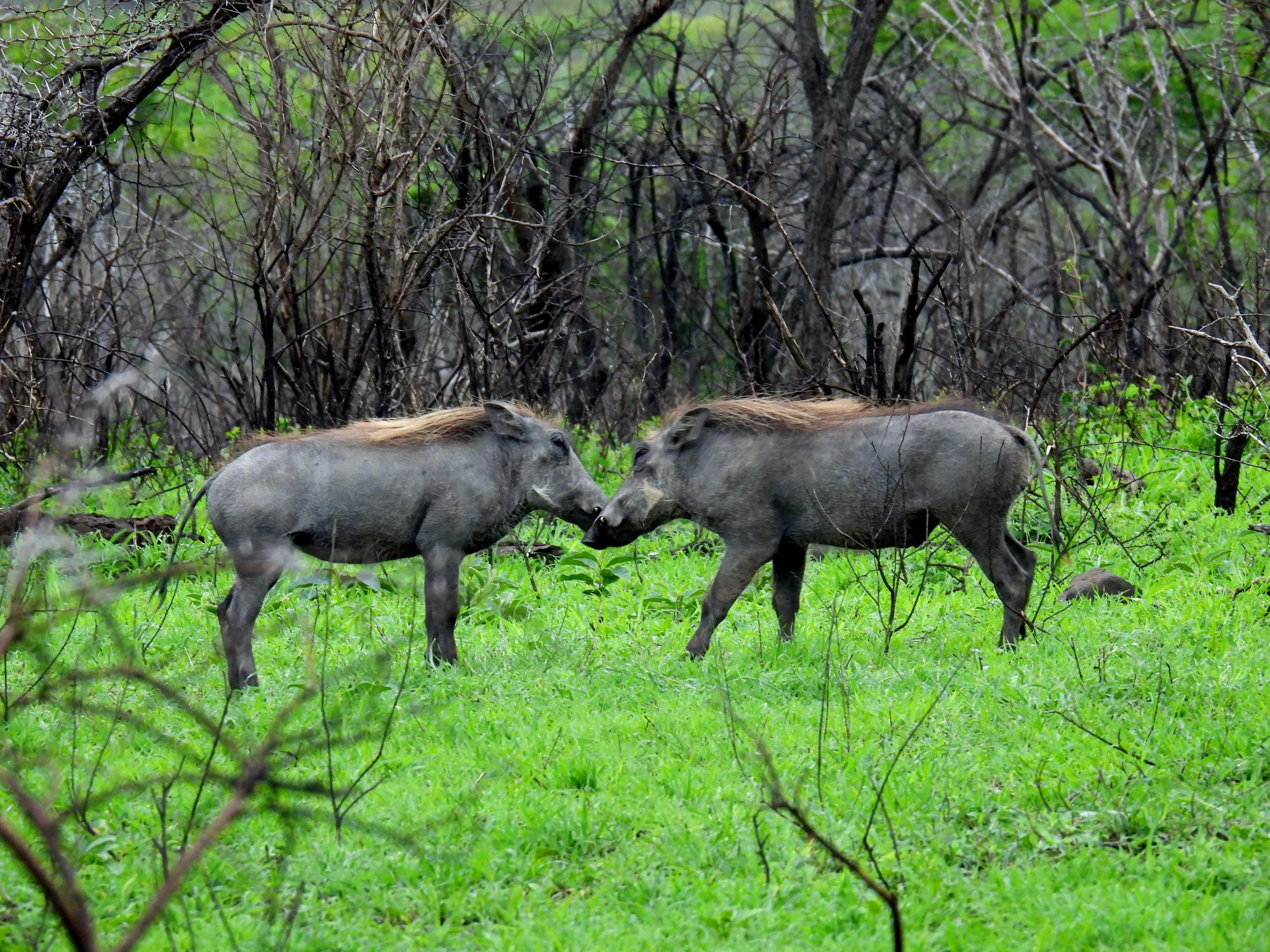
- Nyala, kudu, impala and warthog: seen on almost every drive.
- Hippo and crocodile: in the rivers and larger pools.
Birds
Keen birders will be busy. Look out for vultures circling over the hills, bateleur eagles, the bright purple-crested turaco in the forests and the huge southern ground hornbill walking through the grass. Summer brings migrant birds and the most colour.
Tip: many animals come down to drink in the middle of the day, especially in winter. The park’s hides, where you sit quietly overlooking a waterhole, are a great place to watch them without disturbing them.
When to visit
The park is worth visiting all year round, and each season offers something different.
- Winter, about May to September: dry and mild, with cool mornings and evenings. The bush thins out and animals gather near water, so game viewing is usually at its easiest.
- Summer, about November to March: hot and green, with afternoon thunderstorms. It is the best time for birds and for seeing young animals, and the landscape is at its most beautiful.
- Spring and autumn: a good balance of comfortable weather and good sightings.
Good to know before you go
- Early morning and late afternoon are the best times for game viewing. On our safaris we leave Durban early so we reach the park while animals are still active.
- For your safety, you must stay in the vehicle except at camps, picnic sites, hides and other marked areas.
- Bring binoculars, a hat, sunscreen and a camera with a zoom lens if you have one. Mornings can be cold in winter, so pack a warm layer.
- Gate opening and closing times change with the seasons, and there are speed limits throughout the park. Your guide plans the day around them.
- The park is in a very low-risk malaria area. Ask your doctor or a travel clinic for current advice before you travel.
Visiting with us
We run day and overnight safaris into Hluhluwe-iMfolozi Park from Durban, with hotel pick-up, a qualified guide and all gate fees included. Our Big 5 day safari is the easiest way to see the park in one day. To see both sections properly, with time for early-morning drives, choose our 3-day Big 5 overnight safari or our Hilltop and Mpila Camp safari, which includes a night in the unfenced Mpila Camp.
Questions
Can you see the Big 5 in one day?
It is possible, and many of our guests do. Rhino, elephant and buffalo are seen on most trips. Lion and leopard are harder to find, so an overnight safari gives you a much better chance of seeing all five.
Is Hluhluwe-iMfolozi better than Kruger?
They are different. Kruger is much larger and further away. Hluhluwe-iMfolozi is smaller, hillier and only about three hours from Durban, and it is one of the best places anywhere to see rhino. For visitors staying in Durban, it is the natural choice.
How do I pronounce the name?
Roughly shloo-SHLOO-weh ee-m-fo-LOH-zee. The ‘hl’ is a Zulu sound, a little like a soft ‘shl’.
Is the park safe to visit?
Yes. The park is well managed, and as long as you follow the rules, such as staying in the vehicle, it is very safe. Travelling with an experienced guide makes it even easier.